
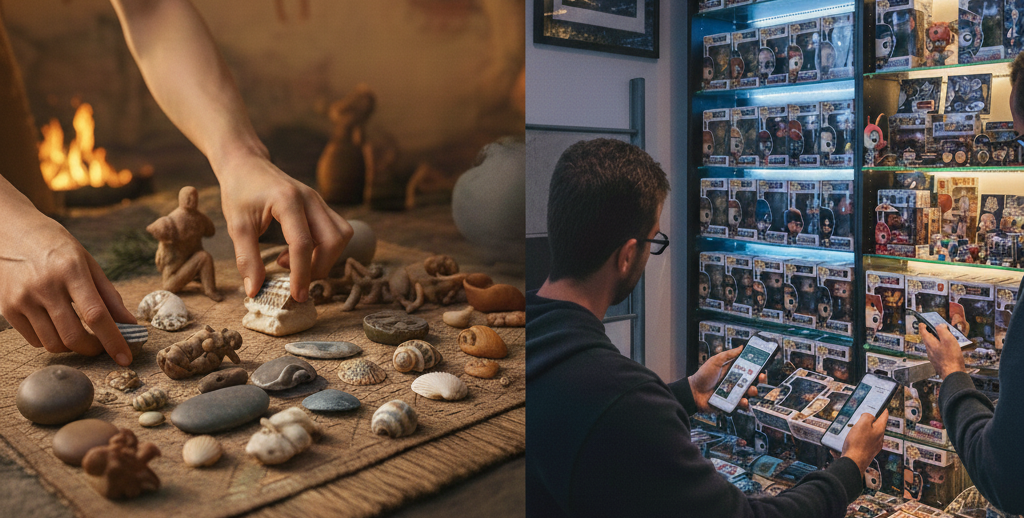
For as long as humans have been humans, we’ve had the urge to gather, group, and guard objects that mean something to us. Whether it was rare stones, carved bones, or brightly colored shells, our ancestors were already doing a primitive version of what we now call collecting.
Fast-forward tens of thousands of years and the instinct hasn’t disappeared. It’s evolved — dramatically. What started as survival and status has transformed into an entire cultural ecosystem of trading cards, sports memorabilia, movie figurines, Funko Pops, and limited-edition everything.
So what happened between prehistoric beads and sealed booster boxes? And why does collecting still feel so universal and exciting — even necessary — today?
Let’s take a look at how an ancient instinct became one of the most vibrant parts of modern fandom culture.
The First Collectors: Before Civilization Had a Name
Long before shelves were lined with mint-in-box toys, humans collected items for reasons tied to survival and identity.
Archaeologists have found ancient caches of beads, shells, pigments, animal teeth, and carved figurines stored together intentionally. These weren’t random piles — they were curated, protected collections.
Why?
- Status: Rare or beautiful objects showed social standing.
- Memory: Items preserved stories, myths, or personal milestones.
- Identity: Tribes used specific objects as cultural markers.
Even then, we were already assigning emotional weight to things that had no direct survival purpose. That mental spark never went away — it just adapted.
The Rise of “Real” Collections: Cabinets of Curiosity
As civilizations formed, so did more formal collections.
Ancient Egypt, Greece, and Rome were full of rulers and elites who displayed rare artifacts, exotic animals, coins, and artworks. These early “museums” weren’t public, but they fueled the same impulse: to preserve, admire, and show off what mattered to them.
By the Renaissance, wealthy Europeans were building cabinets of curiosity — rooms packed with fossils, manuscripts, maps, art, and oddities. This era is where collecting shifted from instinct to hobby, and from hobby to cultural trend.
Mass Production Changes Everything
The industrial revolution didn’t just reshape cities — it reshaped collecting itself.
For the first time:
- Goods could be produced in large quantities.
- Identical items could be traded, compared, and catalogued.
- Companies began intentionally creating collectibles to sell.
Enter stamps, coins, trading cards, toys, and brand-driven memorabilia. What was once the luxury of elites became something everyday people could participate in.
And then, one franchise changed the entire landscape.
The Pop-Culture Explosion: Star Wars, Sports, and the Birth of Fandom Collecting
In 1977, Star Wars arrived — and the modern era of fandom collecting took off like a hyperspace jump.
Kenner action figures became a phenomenon, showing companies just how powerful nostalgia and character-driven storytelling could be.
At the same time:
- Baseball cards shifted from kids’ toys to serious memorabilia.
- Comics grew into high-value collector markets.
- Movie and TV merchandise became its own industry.
Suddenly, collecting wasn’t just a hobby — it was a full-fledged culture powered by emotion, storytelling, scarcity, and identity.
From Passion to Lifestyle: The Modern Collector
Today’s collector has an entire universe of options — and the ecosystem is bigger than ever.
Modern collecting is shaped by:
- Nostalgia: Everything old becomes new (and valuable) again.
- Fandom communities: Online groups, conventions, and local shops.
- Limited runs: Chase variants, special editions, exclusives.
- Brand identity: Funko Pops, premium figurines, signed merch.
- Digital hybrids: NFTs and digital card apps, for better or worse.
Whether you grew up with Pokémon, Marvel, sports legends, anime, retro video games, or Star Wars (again), there’s a collecting lane for every type of fan.
And there’s one key shift from the past:
Collecting is no longer just about objects — it’s about experiences, shared enthusiasm, and identity. It’s a way of saying this is who I am and this is what I love.
Why We Still Collect: The Psychology Hasn’t Changed Much
For all the evolution, the core motivators haven’t changed since our ancestors picked up polished stones:
- We love stories. Every item represents a moment or memory.
- We love belonging. Communities are built around shared favorite things.
- We love the hunt. Scarcity creates excitement — and bonding.
- We love preserving meaning. Collections become time capsules of our lives.
And in an age where digital life moves fast, owning something physical — something yours — feels more grounding than ever.
The Future of Collecting: More Connected, More Creative, More “You”
As fandom culture grows, collecting will keep evolving. Expect:
- More crossover between physical and digital items
- More curated drops and limited-edition collaborations
- More personalization
- More “mini-fandoms” forming around niche interests
- More hybrid experiences (events, live openings, mystery boxes, etc.)
One thing is certain: collecting isn’t going anywhere. It’s built into who we are.
Want More Collector Insights?
We’ll be posting deep-dive blogs every week covering everything from collectible history to modern fandom trends, unboxing culture, card-market shifts, toy spotlights, and more.
🔗 About Redzone Digital
Redzone Digital helps brands, creators, and marketplaces unlock new revenue through smarter, gamified commerce. From live-stream shopping and collectible drops to digital engagement and conversion strategy, we turn audiences into loyal customers.
Follow @RedzoneCollectibles for our latest drops, streams, and mystery box events.